Nepal Tour
Everest Base Camp Trek 15 Days
Overview
Everest Base Camp Trek 15 Days | EBC Trek Cost, Itinerary & Guide 2026
The Everest Base Camp Trek 15 Days is one of Nepal's most iconic Himalayan adventures, taking you deep into the legendary Khumbu region and to the base of Mount Everest (8,848.86 m). The trek combines spectacular Himalayan scenery, Sherpa culture, Buddhist monasteries, traditional mountain villages, suspension bridges, glaciers, and unforgettable views of some of the world's highest peaks.
Starting with a scenic flight toward Lukla, the classic Everest Base Camp route passes through Phakding, Namche Bazaar, Tengboche, Dingboche, Lobuche, and Gorak Shep before reaching Everest Base Camp at approximately 5,364 m. The journey also includes an early-morning hike to Kala Patthar, one of the best viewpoints in the region for panoramic views of Everest, Nuptse, Pumori, Ama Dablam, and the surrounding Himalayan range.
The 15-day itinerary is designed with gradual altitude gain and acclimatization in mind, making it a popular option for trekkers who want enough time to adapt to the high-altitude environment while enjoying the Everest region at a comfortable pace.
The Everest Base Camp region is also home to the Sherpa people and the UNESCO-listed Sagarmatha National Park, where trekkers experience a unique combination of Himalayan landscapes, Buddhist culture, wildlife, and mountain communities.
Everest Base Camp Trek Route
The classic 15-day route follows:
Kathmandu → Lukla → Phakding → Namche Bazaar → Tengboche → Dingboche → Lobuche → Gorak Shep → Everest Base Camp → Kala Patthar → Pheriche → Namche Bazaar → Lukla → Kathmandu
The Nepal Tourism Board describes Lukla as the gateway to Everest and the classic trek as beginning and ending in Lukla.
Everest Base Camp Trek Distance
The total walking distance varies depending on the exact itinerary and side hikes, but the classic Lukla–Everest Base Camp–Lukla route is commonly around 120–130 km round trip.
The actual distance is less important than the altitude profile. At high altitude, even relatively short walking days can feel physically demanding.
Trekkers should expect approximately 5–8 hours of walking on many trekking days, with shorter acclimatization days included.
Everest Base Camp Trek Difficulty
The Everest Base Camp Trek is considered a challenging high-altitude trek.
You do not need mountaineering or technical climbing experience for the standard EBC route, but you need reasonable fitness, preparation and the ability to walk for several hours on consecutive days.
The biggest challenge is generally altitude rather than technical climbing.
Potential difficulties include:
High altitude
Reduced oxygen levels
Long walking days
Steep ascents and descents
Rocky and uneven trails
Cold temperatures
Changing mountain weather
Fatigue
Risk of altitude sickness
Good acclimatization is therefore one of the most important parts of the itinerary.
Can Beginners Do the Everest Base Camp Trek?
Yes. A physically fit beginner can complete the Everest Base Camp Trek with proper preparation and a well-designed itinerary.
Previous high-altitude trekking experience is helpful but not mandatory.
Beginners should prepare by:
Walking regularly before the trek
Building cardiovascular endurance
Including uphill and downhill walking
Strengthening the legs and core
Practicing longer weekend hikes
Staying properly hydrated
Following the guide's acclimatization recommendations
Understanding the symptoms of altitude sickness
A beginner should not attempt to rush the trek simply to reduce the number of days.
Everest Base Camp Trek Altitude
Altitude is one of the defining features of this trek.
LocationApprox. ElevationKathmandu1,400 mLukla2,840 mPhakding2,610 mNamche Bazaar3,440 mTengboche3,860 mDingboche4,410 mLobuche4,910 mGorak Shep5,164 mEverest Base Camp5,364 mKala PattharAround 5,500+ m
Mount Everest itself rises to 8,848.86 m, while the standard Everest Base Camp trek does not involve climbing to the summit.
Everest Base Camp Trek Cost 2026
The Everest Base Camp Trek cost in 2026 depends on the trekking company, group size, accommodation standard, transportation, guide and porter arrangements, and optional services.
A typical guided 15-day package may fall approximately within the range of:
USD 1,500–2,500 per person
Premium and luxury packages can cost considerably more, particularly when they include upgraded accommodation, private transportation, helicopter flights, private guides, or other premium services.
A final price should always clearly state what is included.
The package can include:
Airport transfers
Kathmandu hotel accommodation
Lukla flights
Trekking guide
Porter service
Teahouse accommodation during the trek
Meals according to the package
Sagarmatha National Park entry
TIMS registration
Local trekking permits
Guide and porter insurance
Kathmandu–Lukla–Kathmandu transportation
Basic trekking equipment where specified
Government and local taxes
The exact cost should be confirmed at the time of booking because transportation, accommodation and operational costs can change.
Everest Base Camp Trek Permits
The Everest Base Camp route requires the necessary trekking documentation.
The Nepal Tourism Board currently lists the Everest Base Camp Trek among routes where trekkers must be accompanied by a licensed trekking guide and carry an agency-issued TIMS card.
The trek also passes through Sagarmatha National Park, which currently lists an entrance fee of NPR 3,000 for foreign visitors.
Your trekking agency should arrange the required permits and documentation before and during the trek.
Accommodation During Everest Base Camp Trek
Accommodation on the Everest Base Camp route is primarily provided by mountain lodges and teahouses.
In Kathmandu, travelers generally stay in a comfortable hotel according to the selected package.
During the trek, accommodation typically consists of:
Twin-sharing rooms
Basic beds and mattresses
Blankets
Shared bathrooms in many locations
Dining rooms
Hot meals
Hot showers at additional cost in many lodges
Wi-Fi at selected lodges for an additional fee
Accommodation becomes increasingly basic as you travel toward Gorak Shep and Everest Base Camp.
Food During Everest Base Camp Trek
Teahouses and lodges along the route offer a variety of meals.
Common options include:
Dal Bhat
Rice
Noodles
Pasta
Soup
Potatoes
Eggs
Bread
Tibetan bread
Momo
Porridge
Pancakes
Tea
Coffee
Dal Bhat remains one of the most popular choices because it provides carbohydrates and protein needed for long trekking days.
At higher elevations, food choices can become more limited.
Best Time for Everest Base Camp Trek
The best seasons for the Everest Base Camp Trek are generally:
Spring: March to May
Spring provides relatively stable weather and excellent mountain views.
The trails become colorful with blooming rhododendrons, particularly at lower elevations.
Autumn: September to November
Autumn is another excellent trekking season.
The monsoon has generally cleared, visibility is often excellent, and daytime conditions are favorable for trekking.
Winter: December to February
Winter trekking is possible for experienced and well-prepared trekkers, but temperatures can be extremely cold, especially at higher elevations.
Snow and freezing temperatures can make the route more demanding.
Monsoon: June to August
The Everest region receives more rainfall during the monsoon period. Clouds, rain and flight disruptions can affect travel plans.
For most trekkers seeking the best combination of weather and mountain visibility, March–May and September–November are the preferred seasons. The Nepal Tourism Board also identifies March–May and October–November among the favorable periods for the Everest region.
Everest Base Camp Weather and Temperature
Weather changes rapidly in the Everest region.
Temperatures vary significantly according to altitude and season.
At higher elevations, nighttime temperatures can drop well below freezing, particularly during winter.
Trekkers should prepare for:
Strong sunlight
Cold mornings
Freezing nights
Wind
Snow
Sudden weather changes
Rain at lower elevations
Reduced temperatures at higher elevations
Proper layering is essential.
Altitude Sickness During Everest Base Camp Trek
Altitude sickness is one of the most important risks to understand before starting the trek.
As altitude increases, oxygen availability decreases. Some trekkers may experience symptoms such as:
Headache
Loss of appetite
Nausea
Dizziness
Fatigue
Difficulty sleeping
Shortness of breath
Never ignore worsening symptoms.
The safest approach is to ascend gradually, allow adequate acclimatization, stay hydrated, and immediately inform your guide if you feel unwell.
Severe symptoms can become life-threatening. In such situations, descending to a lower altitude is often essential.
How to Prepare for Everest Base Camp Trek
Start preparing several weeks before your departure.
Cardiovascular Training
Walking, running, cycling, swimming and stair climbing can improve endurance.
Hiking Practice
Include regular hikes with elevation gain.
Try to become comfortable walking for several hours at a time.
Strength Training
Focus on:
Squats
Lunges
Step-ups
Calf raises
Core exercises
Mental Preparation
The trek involves long days, cold temperatures and physically demanding terrain.
A positive mindset and patience are important.
Practice With Your Backpack
Train with a backpack similar to what you will carry during the trek.
What to Pack for Everest Base Camp Trek
Essential equipment includes:
Trekking boots
Trekking socks
Thermal base layers
Fleece jacket
Down jacket
Waterproof jacket
Waterproof trousers
Trekking trousers
Warm gloves
Hat
Sunglasses
Sleeping bag
Trekking poles
Headlamp
Water bottle
Water purification tablets or filter
Sunscreen
Lip balm
Personal medication
Basic first-aid supplies
Backpack or daypack
Duffel bag
Power bank
Universal adapter
Toiletries
The exact packing list depends on the season and trekking company.
Everest Base Camp Trek Safety
Safety should always be the priority on a high-altitude trek.
We recommend:
Trekking with a licensed guide
Following the planned acclimatization schedule
Staying hydrated
Walking at a comfortable pace
Eating enough food
Avoiding unnecessary alcohol
Informing your guide about health problems
Checking weather conditions
Carrying appropriate clothing
Having travel insurance that covers high-altitude trekking and emergency evacuation
Never ignoring symptoms of altitude sickness
Lukla Flight Information
The flight to Lukla is one of the most exciting parts of the Everest Base Camp adventure.
Mountain weather can change quickly, and flights may sometimes be delayed or cancelled because of weather or operational conditions.
During periods of high traffic, flight operations may be scheduled through Ramechhap Airport, requiring an overland transfer from Kathmandu before the flight to Lukla.
Because flight schedules and operating arrangements can change, trekkers should keep some flexibility in their itinerary.
A contingency day is highly recommended.
Everest Base Camp Trek Without Lukla Flight
Travelers who prefer to avoid flying can choose an overland approach to the Everest region.
One option is to travel toward the lower Everest region by road and begin trekking from a lower-altitude trailhead.
This option takes longer than the classic Lukla itinerary but can be suitable for travelers who prefer a road-and-trekking experience.
Everest Base Camp Trek With Helicopter
Travelers with limited time can consider a helicopter option.
Popular alternatives include:
Everest Base Camp Trek Return by Helicopter
Trek from Lukla toward Everest Base Camp and return by helicopter after reaching the higher Everest region, subject to weather, operational and aviation conditions.
Everest Base Camp Helicopter Tour
Travel directly by helicopter for a much shorter Everest experience.
This is suitable for travelers who have limited time but still want to see Everest Base Camp and the surrounding Himalayan landscape.
Helicopter pricing varies according to season, passenger numbers, route and operational conditions.
Everest Base Camp Trek vs Everest Summit Expedition
The Everest Base Camp Trek and Mount Everest Summit Expedition are completely different experiences.
The EBC trek takes travelers to the base camp area at approximately 5,364 m.
An Everest summit expedition involves climbing Mount Everest itself to 8,848.86 m and requires extensive mountaineering experience, technical preparation, specialized equipment, permits, support teams and significant expedition planning.
Reaching Everest Base Camp does not mean climbing Mount Everest.
Mountains Seen During Everest Base Camp Trek
The Everest region offers views of many spectacular Himalayan peaks, including:
Mount Everest – 8,848.86 m
Lhotse – 8,516 m
Makalu – 8,485 m
Cho Oyu – 8,201 m
Nuptse – 7,861 m
Ama Dablam – 6,812 m
Thamserku – 6,623 m
Kangtega – approximately 6,782 m
Pumori – approximately 7,161 m
Island Peak – 6,189 m
The combination of enormous peaks, glaciers, valleys and traditional settlements is what makes the Everest region one of the world's most recognizable trekking destinations.
Why Choose the Everest Base Camp Trek?
The Everest Base Camp Trek is more than simply reaching a destination.
It is a journey through the heart of the Khumbu Himalayas.
Along the route, you experience:
Adventure — challenging mountain trails and high-altitude landscapes.
Culture — Sherpa villages, monasteries and Buddhist traditions.
Nature — forests, rivers, glaciers and alpine landscapes.
Mountains — some of the world's highest peaks surrounding the trail.
People — warm hospitality from communities living in one of the world's most demanding environments.
The Nepal Tourism Board describes the Everest region as a combination of Himalayan landscapes, Sherpa communities, monasteries and challenging high-altitude trekking.
Everest Base Camp Trek FAQs
How many days does the Everest Base Camp Trek take?
The classic Everest Base Camp Trek generally takes around two weeks, depending on the itinerary, acclimatization schedule and transportation arrangements. A 15-day itinerary provides enough time for acclimatization and contingency planning.
How high is Everest Base Camp?
Everest Base Camp on the Nepal side is approximately 5,364 m (17,598 ft) above sea level.
How high is Mount Everest?
Mount Everest stands at 8,848.86 m (29,031.7 ft) above sea level.
Is Everest Base Camp Trek difficult?
Yes. It is considered a challenging high-altitude trek because of long walking days, steep terrain, cold weather and altitude.
Can a beginner trek to Everest Base Camp?
Yes. Beginners with good fitness and proper preparation can complete the trek, particularly with a professional guide and adequate acclimatization.
Is Everest Base Camp Trek safe?
The trek can be completed safely when properly planned, but high altitude creates genuine risks. Weather, altitude sickness, dehydration and exhaustion should be taken seriously.
What is the best month for Everest Base Camp Trek?
March, April, May, October and November are among the most popular months. September can also offer good conditions as the monsoon period ends.
How much does Everest Base Camp Trek cost in 2026?
A standard guided 15-day package can typically range around USD 1,500–2,500 per person, although the actual price depends on services, group size, accommodation and transportation.
Do I need a guide for Everest Base Camp?
Yes. Under the current TIMS provisions listed by the Nepal Tourism Board, Everest Base Camp Trek is among the routes requiring trekkers to be accompanied by a licensed trekking guide and carry an agency-issued TIMS card.
Do I need travel insurance?
Yes. Comprehensive travel insurance covering high-altitude trekking and emergency evacuation is strongly recommended.
Can I do Everest Base Camp Trek without flying?
Yes. You can choose an overland approach to the Everest region, although it generally requires additional trekking days.
Can I return from Everest Base Camp by helicopter?
Yes, helicopter return options are available depending on weather, aircraft availability, passenger numbers and operational conditions.
Alternative Everest Trekking Packages
If you want to explore more of the Everest region, consider:
Everest Base Camp Trek Return by Helicopter
Everest Base Camp Luxury Lodge Trek
Everest Base Camp and Gokyo Lakes Trek
Everest Three High Passes Trek
Everest Base Camp with Island Peak Climbing
Everest View Trek
Everest Helicopter Tour
Book Your Everest Base Camp Trek 2026
The Everest Base Camp Trek 15 Days is an unforgettable journey through Nepal's legendary Khumbu region.
From the exciting flight toward Lukla and the lively streets of Namche Bazaar to the peaceful Tengboche Monastery, dramatic Khumbu Glacier, Everest Base Camp and sunrise from Kala Patthar, every stage of the trek offers something extraordinary.
With proper preparation, a carefully planned itinerary, experienced trekking staff and adequate acclimatization, you can experience one of the world's greatest trekking adventures.
Start planning your Everest Base Camp Trek 2026 and turn your Himalayan dream into an unforgettable journey.
Note: Trekking routes, flight operations, permit requirements, accommodation availability and prices can change. Confirm current arrangements with your trekking agency before departure.
Trip Highlights
- Reach Everest Base Camp at around 5,364 m
- Sunrise hike to Kala Patthar
- Spectacular views of Mount Everest and the Khumbu Himalayas
- Explore the famous Sherpa town of Namche Bazaar
- Visit the historic Tengboche Monastery
- Walk through Sagarmatha National Park
- Cross suspension bridges over the Dudh Koshi River
- Experience traditional Sherpa villages and mountain hospitality
- See glaciers, moraines, alpine landscapes, and dramatic mountain valleys
- Enjoy views of Everest, Lhotse, Nuptse, Ama Dablam, Thamserku, Kangtega, Pumori and other Himalayan peaks
- Experience one of the world's most famous trekking routes
Day-by-Day Itinerary
A carefully paced 15 Days / 13 Nights journey with a little bit of everything.
Arrive at Tribhuvan International Airport in Kathmandu. Our representative will meet you at the airport and transfer you to your hotel. After check-in, you can rest or explore the surrounding area. In the evening, you will receive a briefing about the Everest Base Camp Trek and meet your guide.
Gallery
A glimpse of what awaits you on Everest Base Camp Trek 15 Days.
 5D / 6N
Kathmandu Pokhara Tour 5 Nights 6 Days
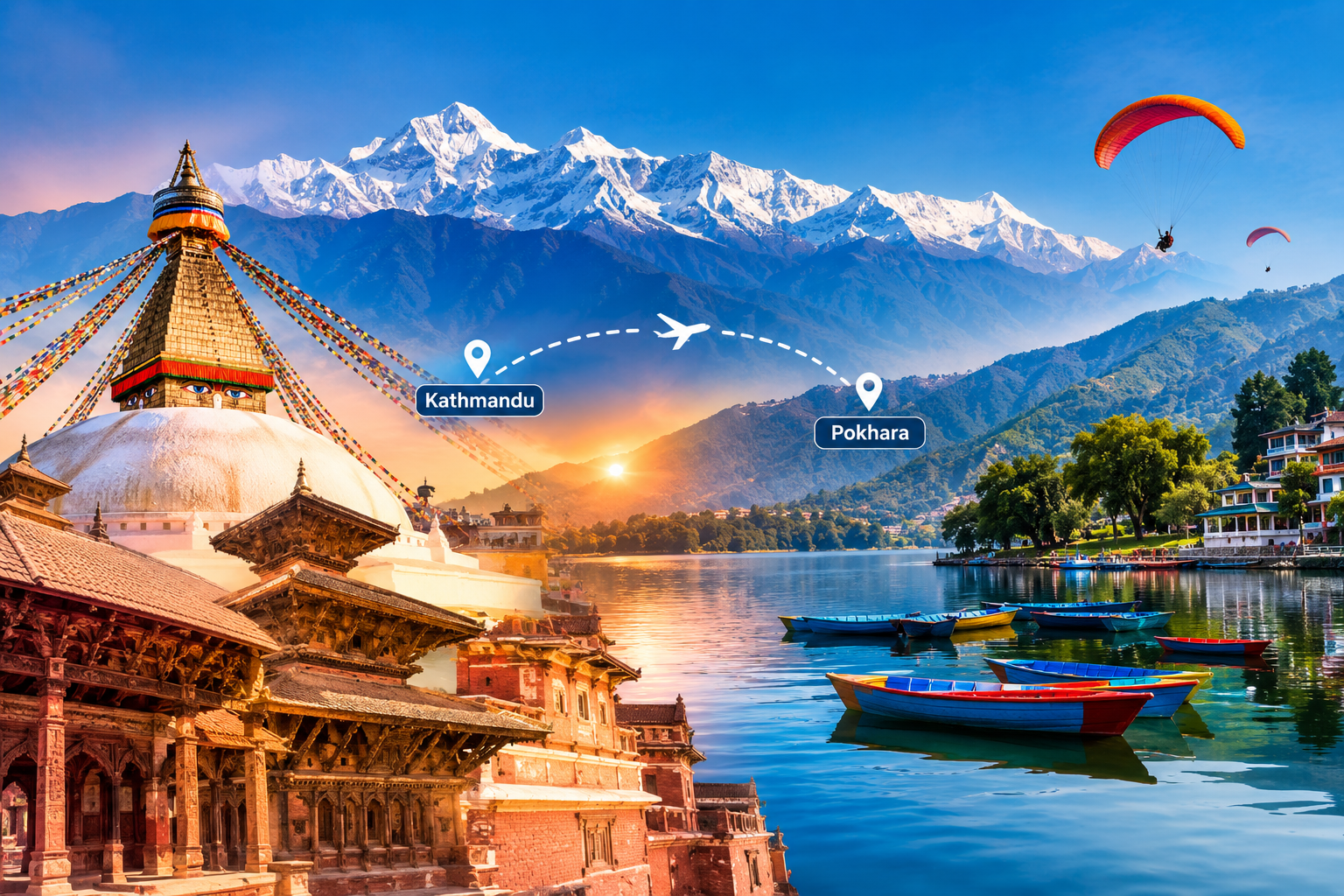
The Kathmandu Pokhara Tour 5 Nights 6 Days offers a blend of vibrant city life and serene natural beauty, making it a popular choice for travelers. Various Kathmandu Pokhara Tour Packages cater to diverse preferences, whether you're looking for a family adventure or a romantic getaway. These Tour Package include comprehensive itineraries covering the major attractions and activities in both cities. The Kathmandu Pokhara Tour Package Price varies depending on the duration and the level of luxury chosen. For families, there are tailored packages that ensure a fun-filled and comfortable experience, while couples can opt for intimate tours that highlight the scenic and cultural richness of the region. Traveling between these cities is made convenient with Kathmandu to Pokhara flights, allowing more time for sightseeing and exploration.
 1D / 0N
Ghandruk Ghorepani Trek - Poonhill Trek 2026
The Ghandruk Ghorepani Trek via Poon Hill, organized by Himalayan Asia Treks, is an enchanting journey through the heart of the Annapurna region, offering stunning mountain views and rich cultural experiences.
 1D / 0N
Day Tour in Nepal
Kathmandu is the bustling, history-filled capital of Nepal, famous for its well-preserved Newar pagodas and centuries-old Hindu and Buddhist monuments. This private sightseeing tour covers two to seven UNESCO-listed sights in a single day, with hotel pickup and drop-off included for your convenience.